
Roles that ask for AI skills advertise a median pay range of $165K to $220K a year in current listings, about $55K more at the floor and $72K more at the top than tech roles that do not ask for AI skills. The catch: only about one in four AI roles discloses pay at all, and remote AI roles are the least likely to show a number.
Salary Spotlight, November 2026. Internal data covers active listings in the Connecting Odds public feed pulled November 26, 2026. Market data checked November 26, 2026.
Key facts
- 619 active listings ask for AI skills (tagged AI, machine learning, LLM, or generative AI) in the 5,000 most recent listings in our public feed.
- Median advertised range for those roles: $165K to $220K a year, based on the 158 postings (25.5%) that disclose pay.
- Tech roles without AI skills advertise $110K to $148K at the median. All listings together sit at $110K to $150K.
- 42% of AI roles that disclose pay top out at $250K or more; only 6% top out under $100K.
- Seniority lifts the floor, not the ceiling: senior-titled AI roles start at a $175K median floor versus $158K for other AI roles, while both top out at a $220K median.
- Remote AI roles disclose pay least often (14.2%), against 36.3% for on-site AI roles, even though nearly half of AI roles (48.8%) are remote.
How much do AI jobs pay right now?
Among active listings that disclose pay, roles asking for AI skills carry the highest advertised ranges of any large group we track:
| Group | Median advertised range | Postings with pay | Share disclosing |
|---|---|---|---|
| Roles asking for AI skills | $165K - $220K | 158 | 25.5% |
| GenAI / LLM roles | $175K - $220K | 55 | 20.9% |
| Tech overall | $124K - $170K | 575 | 24.9% |
| Tech, no AI skills | $110K - $148K | 447 | 23.3% |
| All listings | $110K - $150K | 938 | 18.8% |
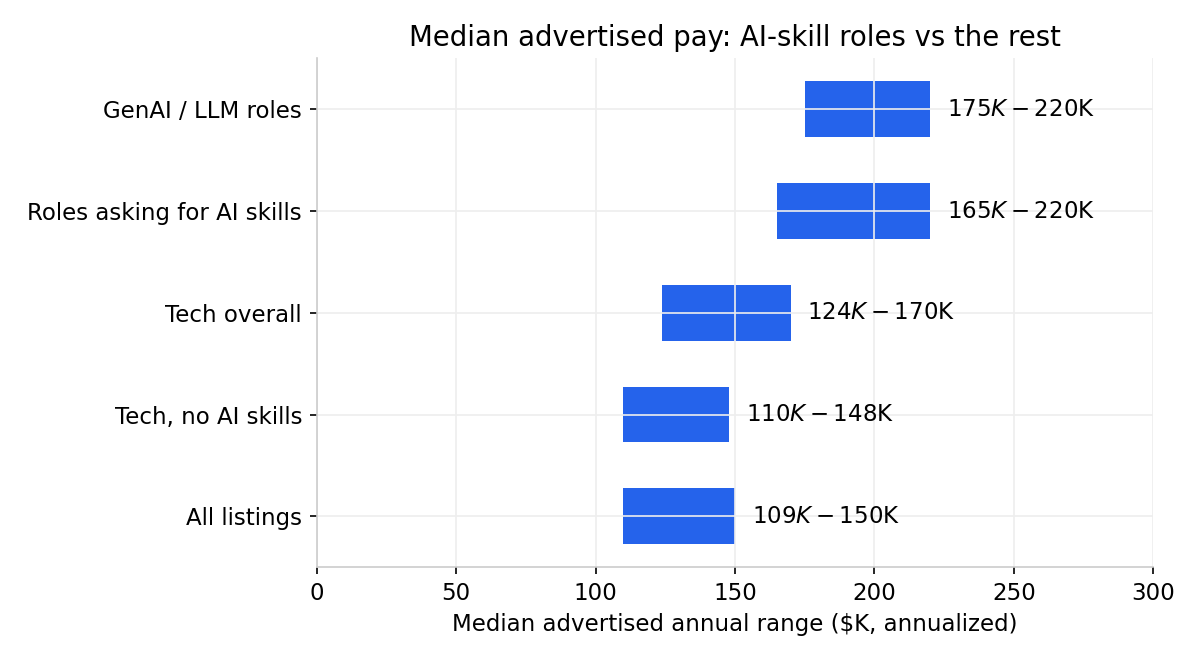
Two things stand out. First, the premium is large in advertised ranges: an AI-skill role's median floor ($165K) is close to the median ceiling of a tech role without AI skills ($148K). Second, roles tagged for generative AI and LLM work sit at the top of the AI group, with a $175K median floor.
A useful cross-check: if we count only postings that state an annual salary directly, with no conversion from hourly or monthly rates, the AI median is higher still, at $175K to $235K (148 postings). The premium is not an artifact of how pay is converted.
AI in the title pays less than AI in the skills
One pattern surprised us. Roles with AI in the job title itself (AI Engineer, Machine Learning Engineer, and similar, after removing co-founder and university thesis postings that use the same words) advertise a median of $140K to $200K, below the $165K to $220K for the wider set of roles that ask for AI skills.
In other words, the money follows the skill requirement inside established engineering roles more than it follows the AI label on a newer title. External data points the same way: Levels.fyi figures compiled in October 2026 put the median total compensation for the bare "AI Engineer" title at $160,000, against $282,950 for machine learning engineers. Titles are new and unsettled; skill requirements are the steadier signal.
Where does AI pay top out?
Looking at the top of the advertised range for the 158 AI roles that disclose pay:
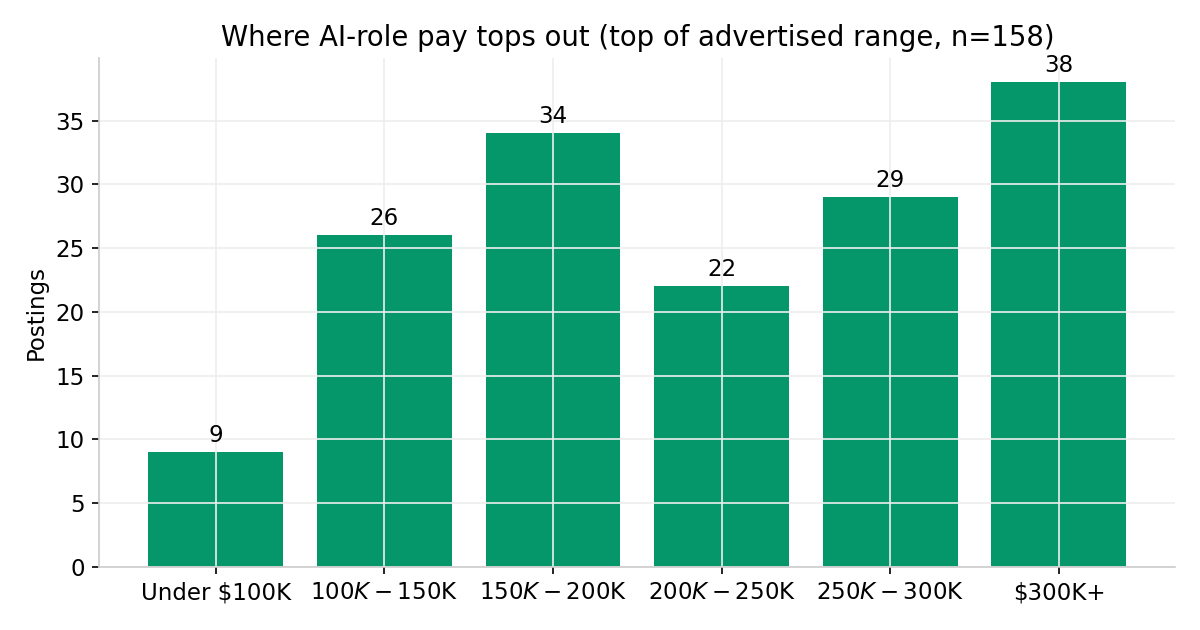
- Under $100K: 9 postings (6%)
- $100K to $150K: 26 (16%)
- $150K to $200K: 34 (22%)
- $200K to $250K: 22 (14%)
- $250K to $300K: 29 (18%)
- $300K and above: 38 (24%)
The single largest band is the top one. Advertised AI pay is not clustered around a middle; it spreads upward, with nearly a quarter of disclosing roles willing to advertise $300K or more at the top of the range.
What moves AI pay up?
Seniority. Senior-titled AI roles (senior, lead, principal, staff, manager, or director in the title) advertise a median floor of $175K, against $158K for AI roles without those markers. The ceiling does not move: both groups top out at a $220K median. Seniority also predicts disclosure: 32.3% of senior-titled AI roles show pay, against 18.2% of the rest.
The skill stack. Inside AI roles, the most common companion skills are Python (166 postings), AWS (93), SQL (64), and the cloud platforms GCP (56) and Azure (52), alongside the AI tags themselves (LLM 219, machine learning 191, generative AI 63). The postings describe engineering roles with an AI core, not prompt-only roles: cloud and data skills are what surround the AI requirement.
Worked example (illustrative). Take two postings with the same shape as the medians above. A platform engineer role that adds LLM and RAG work to a Python and AWS stack advertises around $165K to $220K. A similar platform role with no AI requirement advertises around $110K to $148K. Same family of job, same seniority band; the AI requirement is the visible difference in the advertised range. This example is built from the group medians to show the size of the gap, not copied from a single posting.
Do remote AI jobs pay less?
Nearly half of AI roles in the feed are remote (302 of 619), so this matters. The honest answer has two parts:
- On pay levels: the remote AI roles that disclose pay advertise a median of $169K to $235K, at or above the on-site median of $159K to $220K. There is no visible remote discount in advertised ranges.
- On transparency: only 14.2% of remote AI roles disclose pay, against 36.3% of on-site AI roles. The remote median rests on 43 postings, a small and self-selected set, so read it as "remote roles that show pay show good pay," not as proof about the 86% that stay silent.
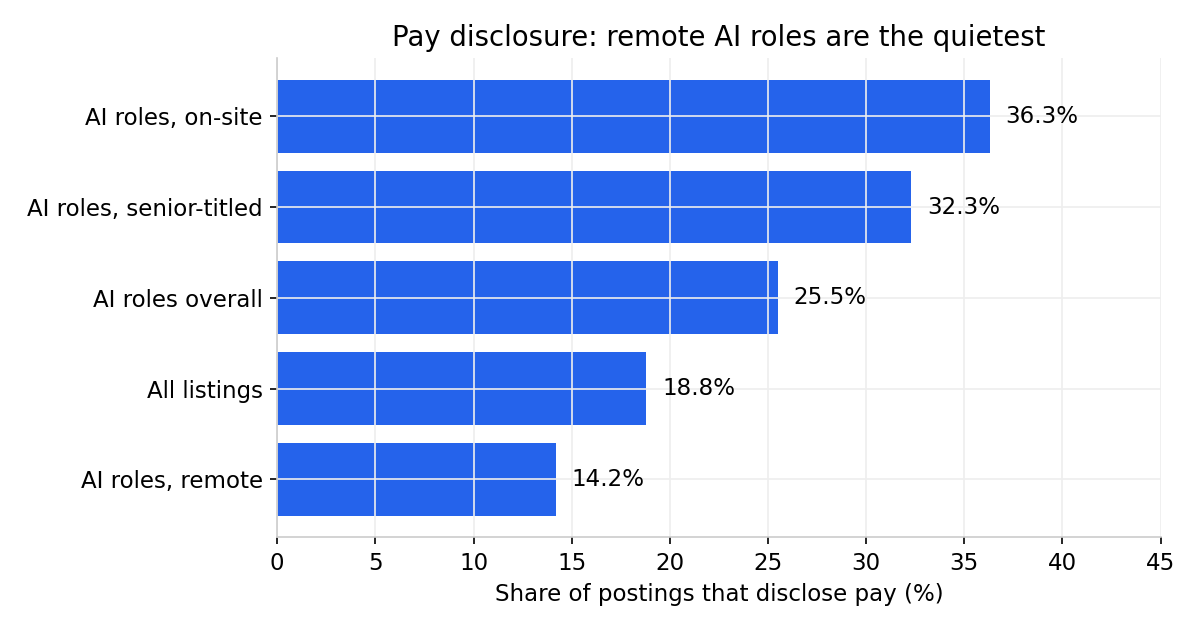
For candidates, the practical point is simple: a remote AI posting without a range is the norm, not a red flag about that one employer. For employers, a disclosed range on a remote AI role is still rare enough to be a differentiator.
How does this compare with the wider market?
This section uses external sources only, kept separate from our listing data above.
- The overall market firmed up in October. US payrolls rose by 165,000 in October, well above the prior 12-month average of 48,000 a month, with unemployment steady at 4.1% and average hourly earnings at $38.00, up 3.1% year over year (BLS, released November 6, 2026). September was revised up to 60,000. AI pay is being set in a market that stopped cooling.
- Like-for-like, the AI premium is smaller than the raw gap. An analysis of 5,354 US engineering jobs with complete advertised ranges (Hotfix, updated November 19, 2026) found AI roles paid 8% to 17% more than other engineering roles at the same seniority. Our raw gap is bigger because it compares across levels and role types; both can be true at once. The premium is real, and part of the headline gap is that AI roles skew senior.
- Total compensation runs higher than advertised base ranges. Levels.fyi data (October 2026) puts median total compensation for machine learning engineers at $282,950 including equity, against $196,500 for software engineers overall, and measured an AI premium of 6.2% at entry level rising to 18.7% at staff level within the same company and level in 2025. Advertised ranges like ours usually describe base salary, so the two measures are not interchangeable.
- The longer trend agrees. Indeed Hiring Lab found pay in AI-exposed occupations has risen 46% since 2021, against 25% for the least exposed. Our snapshot is one month; the direction matches.
What this means for you
If you are job hunting: the advertised premium for AI skills is the largest pay signal in current listings, and it attaches to skills inside engineering roles, not only to AI job titles. Python plus one cloud platform plus LLM or machine learning work is the combination that appears most often. When a posting hides pay, which most remote AI postings do, the medians above give you a grounded range to negotiate from: $165K to $220K is the middle of the advertised market, not an ambitious outlier.
If you are hiring: only a quarter of AI roles disclose pay, and remote roles disclose least of all, so a clear range still sets a posting apart. Expect the competition for AI-skill engineers to price at a $165K floor at the median. And if your range tops out below $150K, know that only about one in five disclosing AI roles sits in that band.
Frequently asked questions
How much do AI jobs pay in 2026?
In current Connecting Odds listings that disclose pay, roles asking for AI skills advertise a median range of $165K to $220K a year. GenAI and LLM roles sit slightly higher at the floor, $175K to $220K. Total compensation at large tech firms runs higher once equity is counted.
Why do these medians look higher than government salary statistics?
Three reasons. Advertised ranges describe what employers offer to attract applicants, not what all current employees earn. Our feed skews toward tech and professional roles. And medians here cover only the minority of postings that disclose pay, which tend to be the more competitive offers.
Do AI job titles pay more than jobs that just require AI skills?
Not in current listings. Roles with AI in the title advertise a median of $140K to $200K, below the $165K to $220K for the wider group of roles that require AI skills. The requirement matters more than the label.
Does remote AI work pay less?
The remote AI roles that disclose pay advertise at or above on-site medians ($169K to $235K against $159K to $220K). But only 14.2% of remote AI roles disclose pay, so the comparison rests on a small set of postings.
How many AI jobs disclose their pay?
About one in four: 25.5% of the 619 AI-skill listings in our feed. Senior-titled and on-site AI roles disclose most often; remote AI roles least often.
Where can I browse current AI roles?
Browse live roles on Connecting Odds at connectingodds.com/jobs, and read the monthly picture in the Connecting Odds October 2026 Jobs Pulse.
Methodology
Internal figures come from the 5,000 most recent listings in the Connecting Odds public jobs feed (connectingodds.com/api/public/jobs.json), pulled November 26, 2026. "AI roles" means listings whose structured skill tags include AI, artificial intelligence, machine learning, LLM, or generative AI (619 listings). Pay medians use the postings that disclose a salary range; hourly, weekly, and monthly rates were converted to annual equivalents (hourly x 2,080, weekly x 52, monthly x 12). A cross-check using only postings that state annual salaries directly gives a higher AI median ($175K to $235K, 148 postings), so the headline figures are the conservative reading. Medians describe the disclosing subset, not all AI hiring. The AI-titled comparison excludes co-founder and university thesis postings, which use AI titles without being salaried roles; one startup-program poster accounts for a large share of those and is part of why the AI disclosure rate is not higher. External figures are from the sources below, checked November 26, 2026, and are not mixed into our listing data.
Sources
- U.S. Bureau of Labor Statistics, Employment Situation, October 2026 (released November 6, 2026)
- Hotfix, AI engineer salary premium analysis (updated November 19, 2026)
- Levels.fyi compensation data, compiled October 2026
- Indeed Hiring Lab, AI-exposure wage analysis, September 2026
- Connecting Odds public jobs feed, pulled November 26, 2026

Discussion (0)
Read the conversation and share your perspective.
Join the discussion
Comments are open to everyone to read. Sign up or sign in to join in.
No comments yet. Be the first to share your perspective.